
All That History #3
January 1972 to August 1972

All That History #3
January 1972 to August 1972
As 1972 --- a Presidential election year ---began, I was 22 years old and, in retrospect, a pretty typical 22-year-old: I was very certain I knew more than I actually did. That said, my future became clearer. Substitute teaching was very comfortable, almost second nature, and it was pointing to starting a Master of Arts in Teaching program come June. While that was spinning my world, the real world was very busy on a number of fronts. Shirley Chisholm, a Black Congresswoman from Brooklyn, announced that she was throwing her hat in the Presidential Democratic primaries and in February Richard Nixon, who had built his reputation as a staunch anti-communist, became the first U.S. President to visit Communist China. That same month we saw the first photos from Mars, as well as the first handheld calculator.
For those around as 1972 began, the most popular tune on the airwaves was Don McLean’s “American Pie,” an infectiously catchy song with lyrics that were symbolic and metaphoric, relating a musical accounting of the 1960’s (starting with “the day the music died” when Buddy Holly, Ritchie Valens, and the Big Bopper were killed in a plane crash in early 1959). While the political parties were gearing up for November, much of my world was focused on popular culture. The first half of 1972 saw Neil Young’s “Harvest” album and Jackson Browne’s “Doctor My Eyes” released while television was dominated by Norman Lear’s All in the Family and Sanford and Son along with The Mary Tyler Moore Show. That Spring Johnny Carson moved The Tonight Show from New York City to Burbank, California and Francis Coppola’s epic, The Godfather, was released. In sports, the New York Knicks lost to the L.A. Lakers for the NBA championship, and women ran in the Boston Marathon for the first time. There was a sense, I think, that the Sixties were definitely “winding down” and it felt as if the Election would reflect exactly how far we were from the high energy of the Counterculture.
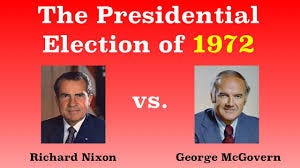
It was clear that Nixon and Agnew would be the Republican candidates for re-election (behind the aptly named CREEP – Committee to RE-Elect the President) but the Democratic Party was, characteristically, scattered, to say the least. Despite Shirley Chisholm’s early announcement, four men dominated the Democratic picture: former Vice President Hubert Humphrey (who lost to Nixon in 1968), Senator George McGovern (S.D.), Senator Edmund Muskie (ME) --- who had been Humphrey’s running mate in ’68 and was out-polling Nixon in early ’72, and Governor George Wallace of Alabama. Wallace had run as an independent third-party candidate in 1968. In early 1972 Wallace declared he had “always” been a moderate Democrat and was seeking the nomination as such.
For those too young to remember who George Wallace was --- let it suffice to say, he was, throughout the 1960s, the most notorious bigot in the nation. And he was the Governor of Alabama! Wallace was famous for declaring, “Segregation now, segregation tomorrow, segregation forever.” In June of 1963, he stood in the doorway at the University of Alabama, defying a Federal order to allow two Black students to register for classes. He ultimately moved but gained widespread national attention as a politician who vigorously opposed any form of integration of the races. By 1968 he mounted an independent, third-party candidacy and won Electoral votes from five southern states. Despite Nixon’s victory in ’68, Wallace believed he was a legitimate candidate for the highest office in the land.
By the time he ran for president in 1972, this time as a Democrat rather than an independent, Wallace had become a national symbol of rage and hate. He fired up the crowd by railing against busing and the elite, continuing his long-standing tactic of stirring up fears among “forgotten” white Americans. (Smithsonian Magazine)
Sounds familiar, doesn’t it? Nixon adapted a lot of Wallace’s strategy to his own campaign, and we can clearly see it is the core of the Republican playbook from that time until the present.
Wallace’s candidacy came to an abrupt halt --- after he had won three Democratic primaries (Florida, Maryland, Michigan) --- in May, at the hands of Arthur Bremer, an unemployed twenty-one-year-old. Bremer had plotted to assassinate either Nixon or Wallace ---because he wanted to be famous! He actually attended Nixon campaign events in April but found the security too tight to penetrate, so Wallace became his target. On May 15, 1972 in Laurel, Maryland, Bremer seized on an opportunity to get close enough to Wallace to put four bullets into his body, paralyzing him for the remainder of his life and ending his campaign.
Earlier in the primaries, Edmund Muskie --- the front runner --- had lost all his momentum on the eve of the crucial New Hampshire primary. A letter surfaced shortly before the primary, claiming Muskie defamed New Hampshire citizens of French-Canadian descent and that his wife regularly used foul language and was a problem drinker. Muskie sought to defuse the situation, claiming the letter had no basis in fact (which, of course it didn’t. It had been created by Nixon’s “dirty tricks” team). While defending the charges against his wife, Muskie broke down in tears, sabotaging his campaign (who wants a President who cries in public?). The path to the Democratic nomination was now wide-open. South Dakota Senator George McGovern, known for his anti-War stance among other liberal positions, was building momentum (just as the Nixon CREEPs hoped!) and, of course, would ultimately lose in a landslide in November.
While all this was going on, I was keeping abreast of the news, but also keeping an eye on the mailbox, watching for admission letters from Harvard and Colgate. Shortly after Muskie crashed and burned but before Wallace was shot, I was accepted to both Master of Arts in Teaching programs I had applied to. Basically, Harvard said, “Welcome. You should be honored we accepted you. No money.” Colgate, on the other hand, said, “Welcome. Here’s a boatload of scholarship money and a PAID teaching internship and, by the way, you’re still eligible for your New York State Regents Scholarship that you won in 1967!” No brainer. As we reached June of 1972, I was heading off to Hamilton, New York --- and an “under the fold” story about a break-in at the Democratic Headquarters at the Watergate Hotel in Washington, D.C., was just starting to get some attention. There was definitely more to come from that story.
As I headed off to my new adventure in the Chenango Valley of upstate New York, the soundtrack now included Cat Stevens and Bill Withers crooning Lean on Me. Movies making a stir included Deliverance, Play it Again, Sam, and two Bruce Lee offerings (The Way of the Dragon, Fist of Fury). We were headed toward the political party Conventions, but I was joining a new cohort of aspiring teachers, with new professors, a new campus, and a new world of possibilities.
As I look back on 1972, I realize that the time between graduation from college (June 1971) and starting school in a new setting (June 1972) had been the first time, since September of 1954, when I started Kindergarten, I wasn’t part of a larger community, a team, if you will. As I was sorting out where I was headed after Yale, my social/cultural sphere was, basically, me and my brother (who dropped out of college in October 1971). Don’t get me wrong, it was fun. We hadn’t had time together like this in four years and loved hanging out, playing guitars, driving our parents a little crazy, and talking, talking, talking (often while driving, driving, driving --- it was Long Island, after all, and suburban car culture is ubiquitous). But now, as I began the Colgate M.A.T. program, I was joining a new community, a new world.
Hamilton is a sleepy little town in central upstate New York, not far from the Finger Lakes region. The town is noted as the home of Colgate University and, indeed, the beautiful campus is its jewel. In the summer of 1972, long before Universities turned their campuses into cash cows, recruiting high school students for summer “college experiences,” there were few students on campus beyond the outgoing M.A.T. class (back to finish writing their theses) and the incoming M.A.T. cohort ---- maybe 100 to 125 graduate students, with a small number of undergrads doing projects with professors.
Aside from the Party conventions, the summer of ‘72 was relatively quiet, news wise . . . which was fine w/me because my focus was on the adventure at hand: the Colgate Master of Arts in Teaching program. Truth be told, I think that, in our Twenties, we’re self-absorbed trying to figure out WHO we are and, WHAT, exactly, we’re going to do with our lives. Certainly, that was the case for me.
My primary soundtrack that summer was Bowie’s Ziggy Stardust & the Spiders from Mars along with Paul Simon’s eponymous solo album. Two new groups, Steely Dan & Eagles, were also on the listening loop. Most interesting, though, was the cohort of aspiring teachers I was joining. Almost everyone had just graduated from college, making me the “senior” member of the group. After meeting the professors from various disciplines (English, Math, Foreign Languages, Science, and Social Studies/History), I felt fortunate to be in the SS/H group led by Bill Moynihan, a brilliant progressive educator.
Our SS/H section featured an energetic and extremely bright collection of individuals from an impressive array of private and public universities. Among them was a fellow Long Islander, also from Suffolk County, Steve Jones. We shared a cynical sense of humor featuring large doses of sarcasm and quickly became fast friends - & that summer’s rendition of Colgate’s Katzenjammer Kids (The Katzenjammer Kids comic strip featured Hans and Fritz, twins who rebelled against authority- Wikipedia). While enjoying the high jinks (nobody was as entertained by us as much as us!), we were also introduced to the worlds of Paolo Freire (The Pedagogy of the Oppressed), Carl Rogers (Freedom to Learn), and Edwin “Ted” Fenton’s “New Social Studies.” Colgate’s M.A.T. program was committed to developing teachers who understood progressive education --- and the idea that students should be at the center of teaching and learning (which, for too many, is still a revolutionary concept).
Another unique feature of Colgate’s program was a concept borrowed from Dwight Allen and Stanford’s Graduate School of Education, “micro-teaching.” As noted in Wikipedia:
Micro-teaching is a teacher training and faculty development technique whereby the teacher reviews a recording of a teaching session, in order to get constructive feedback from peers or students about what has worked and what improvements can be made to their teaching technique. In the original process, a teacher was asked to prepare a short lesson (usually 20 minutes) for a small group of learners who may not have been his/her own students. This was then recorded on video. After the lesson, the teacher, teaching colleagues, a master teacher and the students together viewed the videotape and commented on what they saw happening, referencing the teacher's teaching objectives. Watching the video and getting comments from colleagues and students provide teachers with an often intense "under the microscope" view of their teaching.
The M.A.T. faculty at Colgate made adaptations to the model: we started with a simple 5-minute introductory lesson and built up to 20-to-25-minute lessons over the 6-week program, being videotaped in the morning and de-briefed that same afternoon. Our students were 15 to 20 Hamilton High School upperclassmen --- who were paid to be there. Needless to say, there weren’t “class management” issues but the process was invaluable. (The next two summers --- 1974 & 1975 --- I was hired to be the “microteaching” coach, videotaping and de-briefing the new cohorts of MAT candidates). This combination of theory and practice proved a wonderful first step in not only learning how to teach but also in developing a long-lasting philosophical approach to teaching and learning.
As our summer drew to a close, each teaching candidate was assigned their paid internship assignment, which were either starting right away in September or beginning in late January of 1973. Both Steve and I received Fall assignments, meaning we would be able to find housing together for Spring Semester (more high jinks!!). His internship was in nearby (to Hamilton) Madison, NY and mine was an almost 4-hour drive away in Greenwich, Connecticut (Little did I know how much of my future life would be spent in those environs). We were, of course, excited to get started applying all we had learned in the summer and seeing what would happen when the rubber met the road in the “Real World” of teaching and learning. Little did we know how much this coming year would impact our lives for years and years.
Thanks as always for your wonderful ability to combine the history of the time with your life's trajectory as a student, teacher, and t how it happened. On the 20th day of January, 1972 I delivered a baby boy....so my own history demanded that I pay attention to everything; the war, the national bigotry, food, my intense dislike of Nixon, and the eventual need to send my kid to school....So I started one.