
Object Permanence & The Persistence of Memory

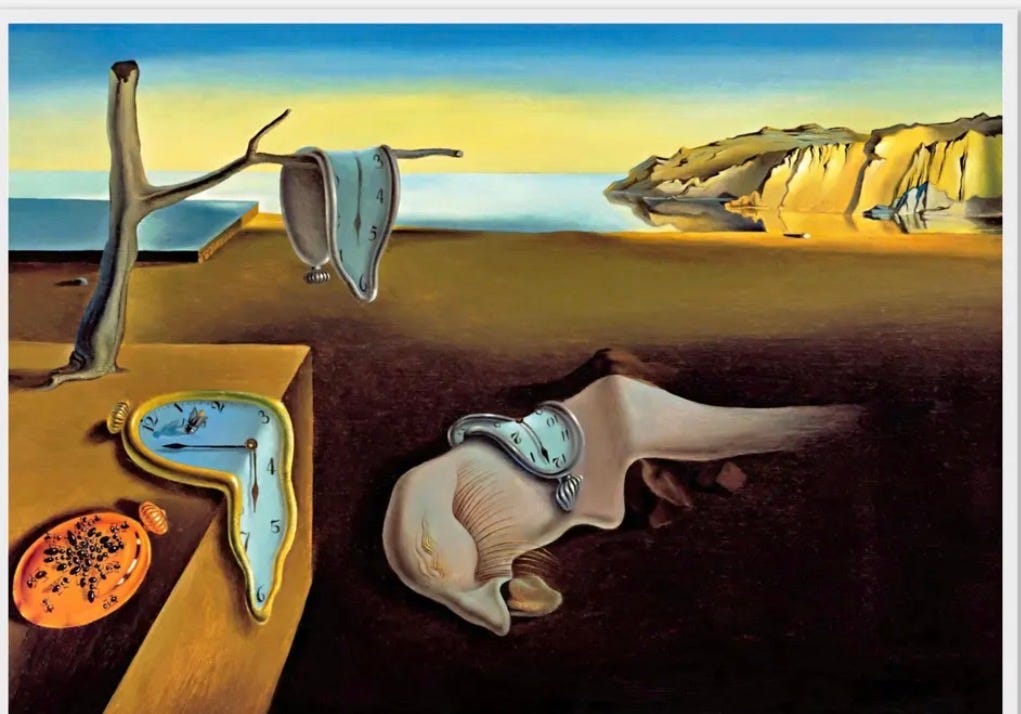
Object permanence is a cognitive skill where children learn that objects continue to exist even when they are out of sight. This milestone typically emerges around 8 to 9 months of age. Understanding object permanence marks an essential step in a child’s mental development and shapes how they interact with the world around them.
The Persistence of Memory by Salvador Dali: Hard objects become inexplicably limp in this bleak and infinite dreamscape, while metal attracts ants like rotting flesh. Mastering what he called “the usual paralyzing tricks of eye-fooling,” Dalí painted with “the most imperialist fury of precision,” he said, but only “to systematize confusion and thus to help discredit completely the world of reality.” It is the classic Surrealist ambition, yet some literal reality is included, too: the distant golden cliffs are the coast of Catalonia, Dalí’s home.
This past weekend (May 29-30, 2026) marked the 55th Reunion of the Yale Class of 1971 (the first co-educated class in Yale’s history) in New Haven, Connecticut. I have attended many of my class’s reunions over the years (heck, I was the Chairman of our first – the 5th --- back in 1976) and it is always an interesting confluence of observations and emotions. I’m relatively certain this one was my last --- but more on that later.
I spent much of my two days in New Haven walking around the campus, remembering events I experienced at various locations between 1967 and 1971 --- as well as noting what had changed. New Haven, in its present configuration, was not unfamiliar to me. I lived there as “recently” as 2008-2009, when I worked in the Teacher Certification Program as a Field Supervisor. It’s understood, of course, that cities evolve, and New Haven is no exception. In strolling around still familiar streets I began to note not only what had changed but how what used to be located in various places reflected not only how New Haven had changed but how it reflected how our culture has evolved.
While I knew that our favorite Burger Joint, Hungry Charlie’s had become Toad’s Place --- a very popular music venue – as far back as 1976, I remembered “what else” used to be along that stretch of York Street (between Elm and Grove Streets) and how that marks some of the way the world has changed in the last 55 years. Two places, in particular, that were “classic” 20th century institutions --- and are barely present in our current landscape --- were Phil’s Barber Shop (replete with four chairs and perfectly groomed older men with Cesar Romero mustaches) and a Typewriter Repair Shop. Around the corner, on Broadway, Cutler’s Records was also gone --- a wonderland of vinyl, always buzzing with customers and filled with the sounds of whatever trending music was in demand. Across the street from Cutler’s, where Elm Street converges with Broadway, J. Press, the men’s haberdashery --- which used to be around the corner on York --- now occupies the space where The Yankee Doodle once fed generations of Yale students. “The Doodle” was a hole-in-the-wall diner with 12 seats squeezed together facing an always-busy grill, serving New Haven’s version of White Castle style sliders --- cooked to perfection with diced onions and a bun with melted butter. The memories of all those places --- Hungry Charlies, Phil’s, the Typewriter Shop, Cutler’s, The Doodle – are vivid, even all these years later. While recognizing “things change,” one doesn’t necessarily mourn the passing of these institutions but there is a genuine sense of loss. It’s almost like a dream --- evoking the Dali painting ---- where you recognize the setting (Mory’s is still there, facing the back of Sterling Memorial Library, after all) --- but still feel a little off-balance and out of place. There is only some Object Permanence intersecting with your Persistence of Memory. It’s disquieting but it’s the reality, as I further discovered visiting a variety of Yale landmarks --- personal and otherwise.
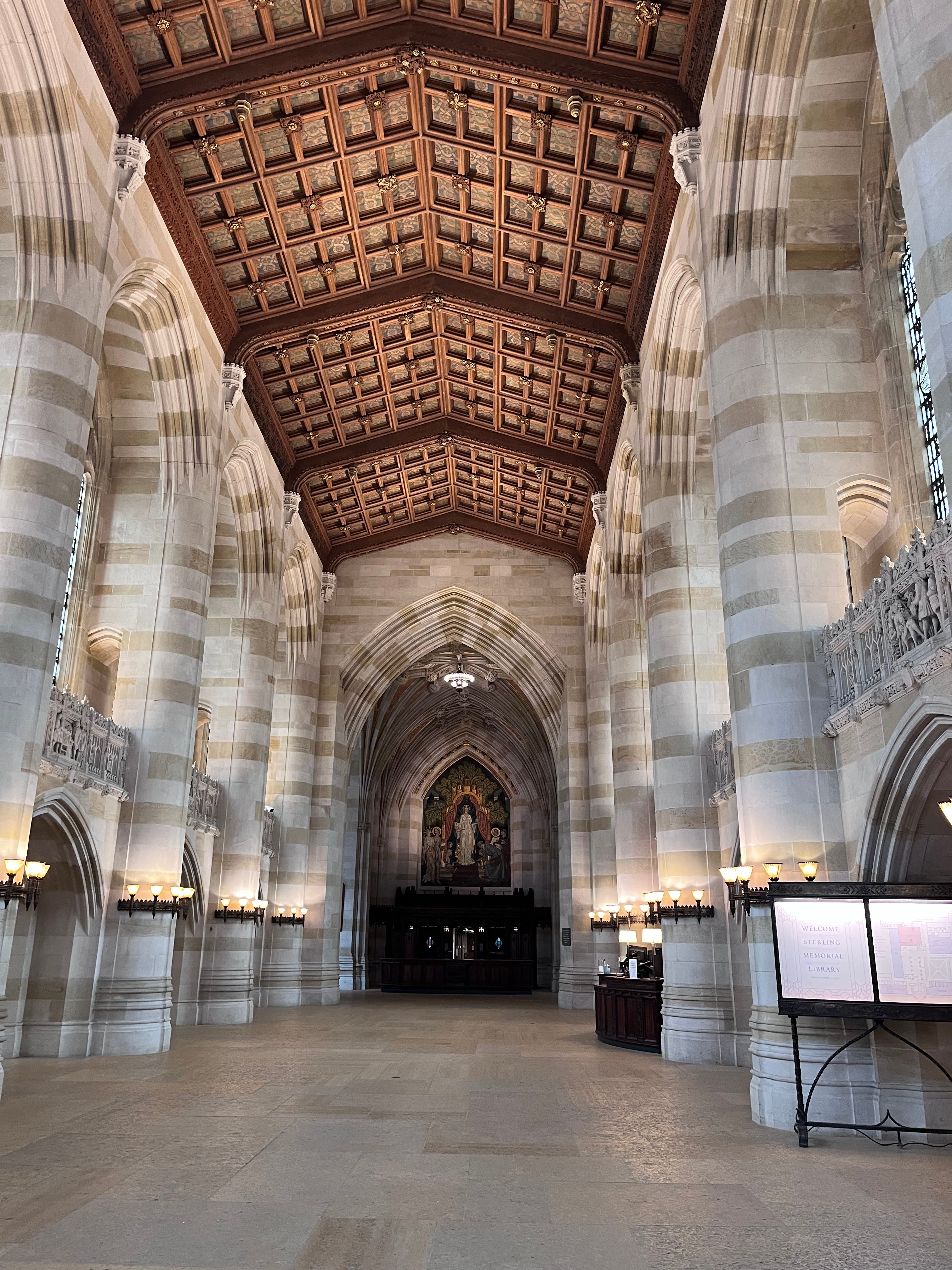
Saturday morning, May 30th, was one of those classic, gray-bordering-on-miserable, windy New Haven days. I arrived from Norwalk a bit after 10:00 a.m., parked in the Chapel-York garage, and, after getting a Starbucks coffee, meandered over to Pierson College (our Reunion HQ) to see if anything was happening. There was a light drizzle, and no one was under the Big Tent in the Pierson Courtyard, so I headed back out to visit the places I remembered spending countless hours in --- Sterling Memorial Library and Vanderbilt Hall. Sterling Memorial Library sits in the middle of the Yale campus, an imposing structure, considered “a masterpiece of Collegiate Gothic architecture” designed by James Gamble Rogers (Google AI). Intentionally created to represent a medieval church, I am still awed when I enter. As in so many cathedrals, one’s eyes are drawn forward (toward the “altar”/main desk) and upward, toward the 44-foot coffered wood ceiling. The side alcoves, which once housed card catalogs, are now open spaces with computer stations in their place. During my senior year, when I lived off-campus in North Guilford, working on my Intensive Major paper (on modern American literature and mythology), any time I was in New Haven, I spent untolled hours in the Linonia and Brothers Reading Room, tucked in a corner alcove, serenely doing research and writing. L & B was a home away from home during that year, but it was renovated in 2024 and, while ‘familiar,” it was not the same. The Persistence of Memory.
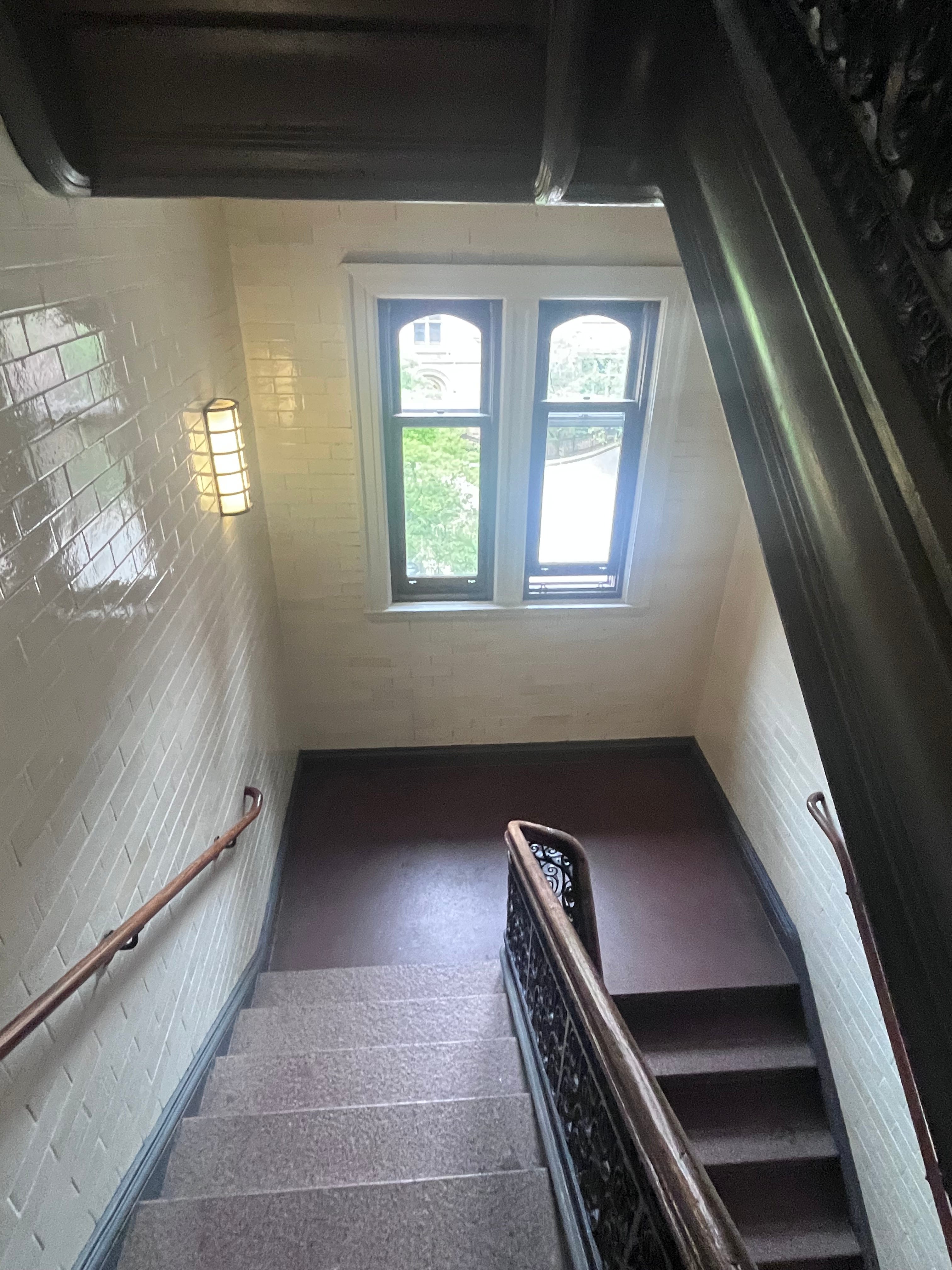
Vanderbilt Hall was built in 1894 and was one of the original “Collegiate Gothic” buildings in the country. The building’s exterior has remained unchanged over the years, with the original room numbers still carved outside the doors of the six entryways. I did not expect to be able to get inside the building (the University is closed by the end of May and, except for reunions and some high school summer session programs everything, other than the libraries, is shut tight) but, as luck would have it, some of Vanderbilt is being used for the high schoolers. And, as more luck would have it, the door for entryway for rooms 58-69, was propped open (I lived in 69 Vanderbilt in 1967-68), giving me a chance to “experience” the building. While it has undergone some alteration to accommodate not only co-education but also an increasing number of undergraduates, the basic “bones” of Vanderbilt were the same. According to the 1894 Springfield Republic, as cited on the “Lost New England” website:
the staircases are of iron and marble. On entering the hallways, one finds the walls lined with white enameled brick, while the iron stairs have marble footsteps and an artistic railing with wooden top.
That description is still accurate --- as is this:
The rooms are wainscoted to a hight [sic] of four feet in paneled oak. The fireplaces are large and constructed with handsome brick, surrounded by woodwork, which extends up over the mantel to a hight of bout [sic] eight feet. A feature of each suite of rooms is the window seat. These seats are made of fine-grained oak, and the lower part of each contains two sets of drawers and two closets.
That description applied in 1967 and still applies today! “The more things change, the more they remain the same,” indeed. There was a Time Machine element to walking up and down the Vanderbilt staircase --- a trek I repeated hundreds of times that year and did again on Saturday, May 30th --- one last trip through the past.
The Reunion itself evoked an array of emotions --- nostalgia, joy, gratitude, sadness.
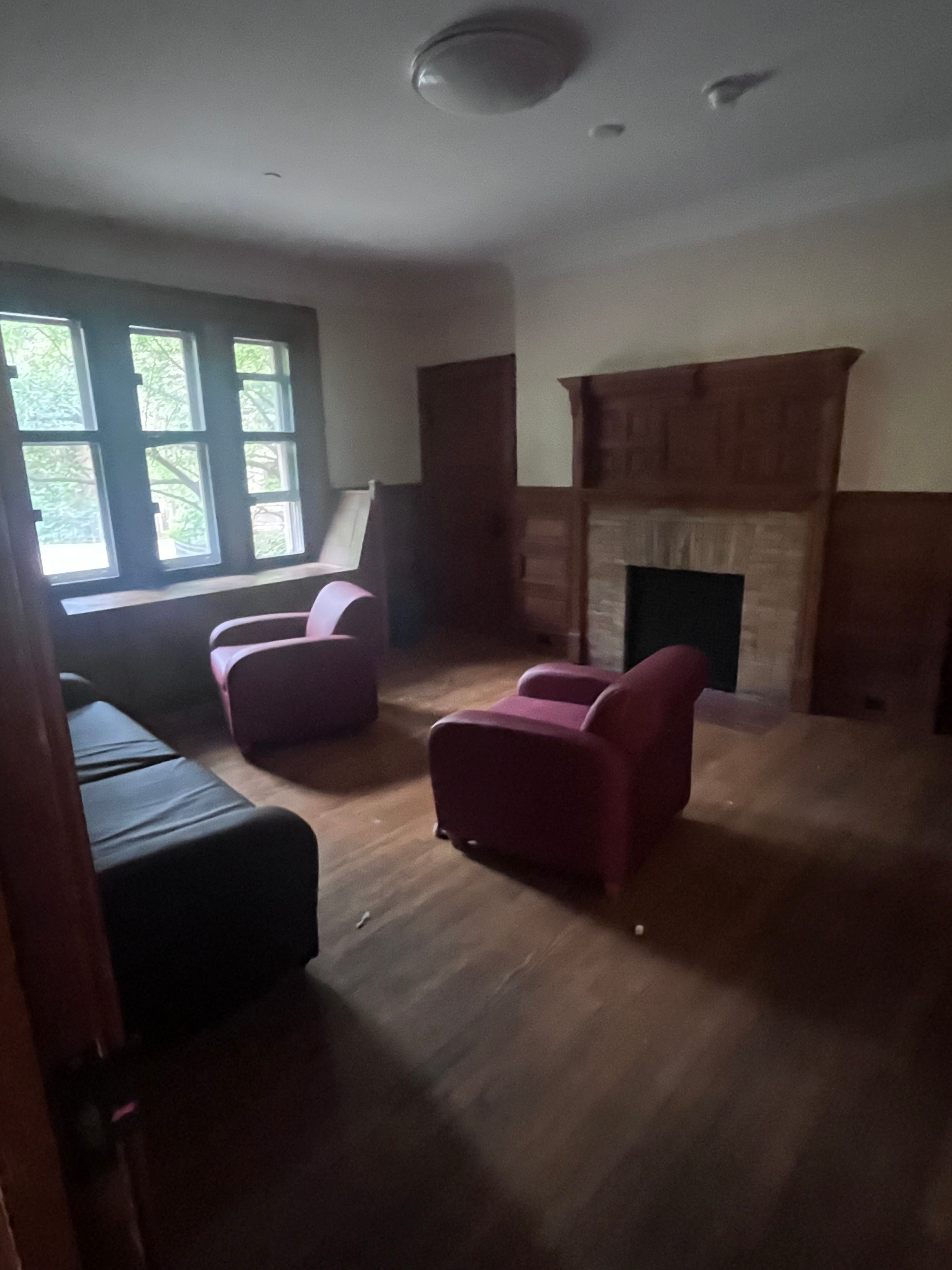
Just being back on campus with two-hundred people I shared that experience with was, invariably, nostalgic. It’s very easy to fall into “remember when we were here?” That was especially true when, on Friday afternoon, a group of us were given a tour of Morse College, our residence (the two or) three years after leaving Vanderbilt Hall. As with the Library and Vanderbilt, Morse has undergone some radical changes but is still a recognizable place. Our visit was especially poignant, though, because one of our classmates --- a regular member of the monthly Zoom calls we’ve conducted since Covid --- had passed away suddenly last summer. His closest friend in our group had brought a pouch with some of Tom’s ashes to the Reunion. We held a brief ceremony of remembrance right there, spreading his ashes beneath a towering tree in the center of the Morse Courtyard. It was a vivid reminder of how long we’ve known each other and, while sad, there was a certain gratitude that we had spent so much time enjoying one another over those years.
Don’t confront me with my failures,
I have not forgotten them.
Jackson Browne, “These Days”
I left New Haven on Saturday afternoon with very mixed feelings. On the positive side, I had particularly enjoyed seeing my classmates from Morse in person, as well as a few of my Skull and Bones compatriots and a bunch of guys I played freshman football with. During past Reunions that has always been the brightest spot --- seeing those people I had spent the most time with between 1967 and 1971. The negative side of this Reunion was: #1 – not being able to wrangle all the Morse attendees for a group photo, as we have done at all the past Reunions. In the same way, we failed to gather the Skull and Bones attendees for a photo, and I had hoped to get all those Freshman Football players together for a picture, too --- and failed there, too. Because of the miserable weather on Saturday, the 30th, it seems folks had scattered to presentations, local shops, the Yale libraries and/or Art galleries, etc. --- making it extremely difficult to bring groups together for reminiscing or pictures, an altogether frustrating circumstance. We did have a Class Memorial for the 46 members we had lost since our last Reunion in 2022. It was a fittingly somber affair --- well-attended and respectful, a proper farewell, indeed, for lost classmates. After that ceremony people, once again, scattered (the weather remained foreboding) and I passed on figuring out how to pass time (it was about 4:00 pm) until the Class Dinner & Dance, scheduled to begin at 6:00 p.m. (the previous night’s meal was supposed to start at 6:00 pm, too, and it didn’t begin until almost 7:00 pm). Given the weather and the sad Memorial, I decided it was time to leave and headed to the Chapel-York Garage.
As I drove home my most palpable emotion was that of sadness. I was sorry I had missed engaging with a number of classmates --- the vicissitudes of Reunion scheduling, bad weather, and a lot of “ships in the night” situations, it seems. But there was also the very real fact that we are, simply put, old. The visible, physical decline of many classmates since our last Reunion was, to me, striking --- as was the absence of several close friends because of issues regarding health, travel, or, in at least one case, a concern about ICE and Border Patrol. I think beneath the cloak of sadness was my sense that this would, in fact, be my last reunion. I live close enough to New Haven that I’m sure I’ll be back again --- the draw of the original Pepe’s Pizza, as well as an annual trip to Ingalls’ Rink insures that. But I think I’m done visiting New Haven with the Class of 1971.
To everything there is a season . . . . For me, I feel lucky --- and quite happy --- to have spent well over half a century as part of Yale’s Class of 1971 but now, continuing with Ecclesiastes, I believe it’s :A time to lose; A time to keep, and a time to cast away. I will lose any regrets associated with the Class and keep all the wonderful, vivid memories I have --- and cast away the line that moored me to the group. It’s time.
This is such a beautiful meditation on time and knowing when to call it. Thank you for your thoughtful reflections, Bil.